1. What passages from these chapters help increase your faith in God’s existence, in His goodness, and/or in the truthfulness of the Church of Jesus Christ of Latter-day Saints?
2. What passages from these chapters help teach, motivate, or inspire you to live better?
3. What prophetic passages do you find in these chapters that you believe relate to the mission of Jesus Christ?
4. What are your favorite passages from these chapters relating to the latter days?
5. What difference does it make to know that we lived with God before we were born and were foreordained to specific missions in mortality?
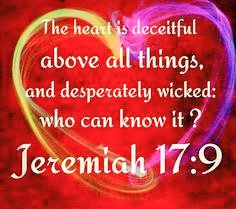
6. What does Jeremiah mean when he says that “The heart is deceitful above all things, and desperately wicked”? (17:9) Isn’t that a pretty pessimistic view of the nature of man? Wouldn’t it be better to emphasize that we are all children of God, with divine potential?
7. Jeremiah 7:22-23 seems to deny that the Lord ever commanded Israel to practice animal sacrifice. Is this an error in the record? Or what is Jeremiah trying to say?
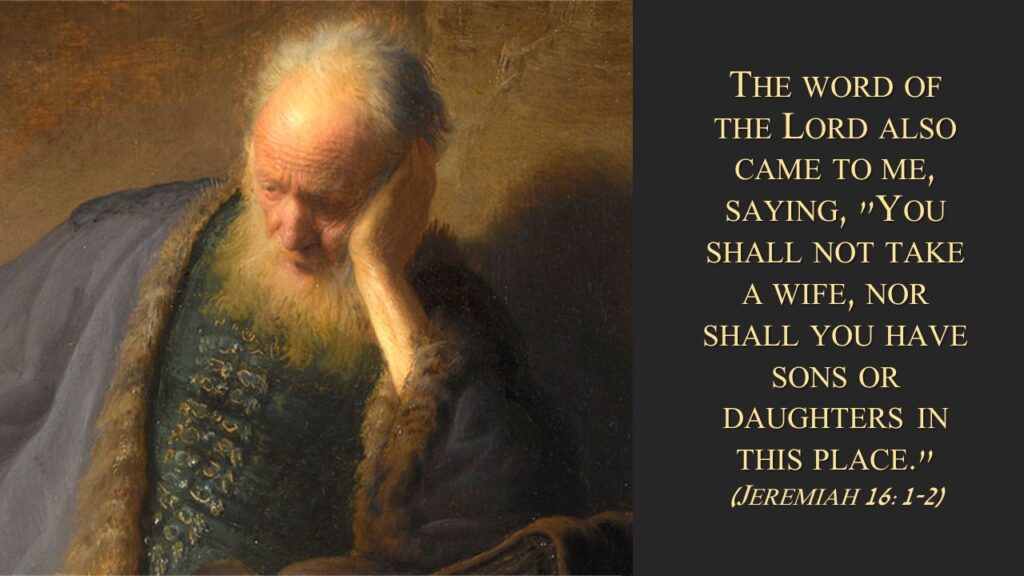
8. Why would the Lord have commanded Jeremiah not to marry and have children (16:2), when exaltation is impossible without an eternal partner, and our greatest blessings come through our family relationships? Is it possible that we, too, should have second thoughts about raising a family in view of deteriorating world conditions?
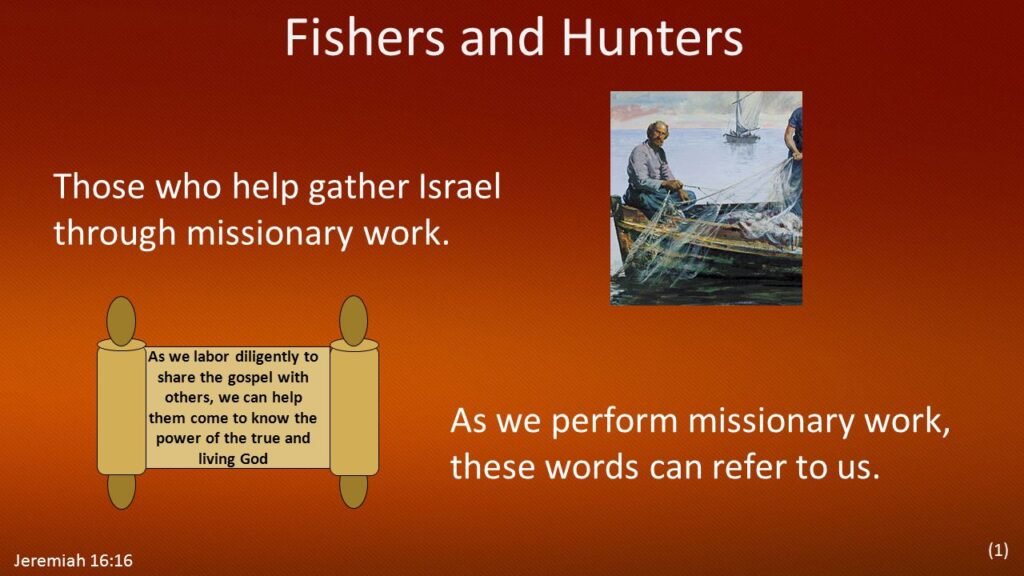
9. Jeremiah compares missionary work to both hunting and fishing. Which, in your opinion, is the better analogy, and why?
Possible Answers to Points to Ponder in Jeremiah 1-3, 7, 16-18, 20
1. What passages from these chapters help increase your faith in God’s existence, in His goodness, and/or in the truthfulness of the Church of Jesus Christ of Latter-day Saints?
My list would include:
1:5: Supports the Latter-day Saint teaching about a premortal life.
1:9: Supports the Latter-day Saint teaching about the corporeal nature of God.
2:11-13: Supports the Latter-day Saint teaching about a Great Apostasy, paralleling the time of Jeremiah in which the true concept of the nature of God would be lost.
3:1: Though Israel had “committed adultery” against the Lord, the Lord was loving and patient enough to welcome her back.
3:3: The Lord, in His love, may bring droughts and other calamities upon His people to get their attention and give them a chance to repent and qualify for His blessings.
7:25: The Lord has constantly sent prophets among His people to warn them.
18:8: Though the Lord may promise destruction to the wicked, He will relent if they repent.
20:9: The Spirit of the Lord can strengthen us as a “burning fire” and impel us to speak.
2. What passages from these chapters help teach, motivate, or inspire you to live better?
My list would include:
1:6-9: Even Jeremiah lacked confidence in his ability, but the Lord was able to use him and put His words into Jeremiah’s mouth.
7:2-7: Only by righteous living, including kindness to the widows and orphans, and not by the formalities of temple worship alone, can we qualify for God’s blessings.
16:16: Latter-day missionary work can be compared to the work of hunters and fishermen.
17:5-8: Cursed is the man that trusts in man and the arm of the flesh, but blessed is he who trusts in the Lord
17:22, 27: The Lord reemphasizes the importance of keeping the sabbath day holy.
20:2: If Jeremiah was fearless even when faced with being put in stocks, I can speak up for the truth as well.
3. What prophetic passages do you find in these chapters that you believe relate to the mission of Jesus Christ?
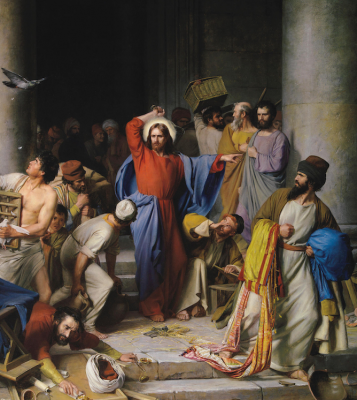
7:11: Jeremiah may not have had Jesus Christ in mind when he spoke of the temple having become a “den of robbers,” but the Savior quoted the passage in Matthew 21:13 and Luke 19:46 at the time he cleansed the temple.
4. What are your favorite passages from these chapters relating to the latter days?
My list would include:
3:14-18: The Latter-day gathering of Israel would be one by one, but in the end would be more spectacular than in the days of the ark of the covenant. The gathering would be not only figurative but literal in that both Judah and Israel would be reunited and come out of the land of the north into the land promised to their fathers as an inheritance.
16:14-16: The latter-day gathering of Israel will eclipse the Exodus of Moses’ day and will include both individual conversion and a geographical gathering.
16:19: Latter-day Gentiles will recognize the errors of their fathers and be receptive to the gospel.
5. What difference does it make to know that we lived with God before we were born and were foreordained to specific missions in mortality?
Your choice. To me, it makes me want to try harder to measure up to the expectations the Lord has for me and to not fall beneath the level of excellence at which I may have performed in my premortal life.
6. What does Jeremiah mean when he says that “The heart is deceitful above all things, and desperately wicked”? (17:9) Isn’t that a pretty pessimistic view of the nature of man? Wouldn’t it be better to emphasize that we are all children of God, with divine potential?
The two ideas are not incompatible. Jeremiah, of course, is saying nothing more than King Benjamin said in Mosiah 3:19, when he taught “The natural man is an enemy to God,” always had been and always would be, unless he put off the natural man and yielded to the enticings of the Holy Spirit.
7. Jeremiah 7:22-23 seems to deny that the Lord ever commanded Israel to practice animal sacrifice. Is this an error in the record? Or what is Jeremiah trying to say?
It is certainly clear enough from multiple Old Testament passages that the Lord did indeed prescribe animal sacrifice. But He is emphasizing through Jeremiah that the principle was not animal sacrifice as such, but obedience, not only to the outward practice but to all of the Lord’s commandments. In Jeremiah’s day, they were practicing only the outward form and had forgotten the deeper meaning.
8. Why would the Lord have commanded Jeremiah not to marry and have children (16:2), when exaltation is impossible without an eternal partner, and our greatest blessings come through our family relationships? Is it possible that we, too, should have second thoughts about raising a family in view of deteriorating world conditions?
The general principle is that we should be eager for marriage to a righteous partner and welcome children into our homes, even today. Jeremiah was a special case. The Lord had a mission for him that would make normal family life impractical. Certainly, the Lord will make it up to Jeremiah in the eternities.
9. Jeremiah compares missionary work to both hunting and fishing. Which, in your opinion, is the better analogy, and why?
I personally prefer the fishing analogy for the following reasons:
A fisherman must bait the hook with something enticing.
At least when fishing with a rod and reel, the fisherman must be patient and wait for the fish to take the bait.
If one hooks a large fish, he must reel it in carefully so as not to break the line, letting out more line if the fish insists on going in the other direction, but keeping enough tension on the line to encourage the fish to come closer.
Fish are usually afraid of fishermen but are less afraid of other fish. Similarly, non-members may be initially less afraid of normal members than of full-time missionaries. The members can thus be an invaluable aid in missionary work.
Related Cartoons for Your Enjoyment
Broken cisterns (Jeremiah 2)
The Unfaithful Bride (Jeremiah 3:1-3)
Jeremiah's object lesson. Jeremiah 13:1-11
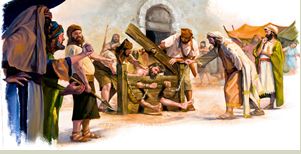
Jeremiah 16:1-8
Jeremiah 19:1-11
Then I said, I will not make mention of him, nor speak any more in his name. But his word was in mine heart as a burning fire shut up in my bones, and I was weary with forbearing, and I could not stay. (Jeremiah 20:9)
To accompany your Come, Follow Me study for March 2-8 In addition to reading these chapters, you may want to look at: Old Testament Scripture Helps for Genesis 24-33 at: Genesis 24–33 Scripture Central Genesis 24-33 - Scripture Central FAIR Let God Prevail The Interpreter Foundation Genesis 24–33 The following videos: If you would like a Kahoot game related to these chapters, click here f or Genesis 24-27 : https://create.kahoot.it/share/genesis-24-27/8bb292fe-01c5-4102-b05e-8c695dde23f9 . For a similar Kahoot related to chapters 28-33, click here: https://create.kahoot.it/share/genesis-28-33/a9f695d4-8573-4120-a57d-047fd808279a . Points to Ponder in Genesis 24- 33 1. How many interesting parallels can you find between the life of Isaac and that of his father, Abraham? 2. What are the most important points to remember, in your opinion, from the story of the marriage of Isaa...
To accompany your Come, Follow Me study for April 27-May 3 In addition to reading the indicated chapters, you may wish to look at: Old Testament Study Helps at Exodus 35–40; Leviticus 1; 4; 16; 19 . Scripture Central Exodus 35-40; Leviticus 1, 4, 16, 19 - Scripture Central FAIR Holiness to the Lord The Interpreter Foundation Exodus 35–40; Leviticus 1; 4; 16; 19 The following videos: If you would like a Kahoot game related to this material, click here: https://create.kahoot.it/share/exodus-35-40-leviticus-1-16-19/0b8b87c2-6c42-4b8f-a865-ebd14f4ce2cd Points to Ponder in Exodus 35-40; Leviticus 1, 4, 16, 19 1. Of what possible value is all the detail in these chapters concerning the construction of the tabernacle? What underlying principles can you discover that apply to our temple worship today? 2. Why did Moses ask for donations only from the willing-hearted? (Exodus 35:5, 21-22, 29, 36:2, Wouldn’t it h...
To accompany your Come, Follow Me study for the week of May 11-17 I n addition to reading the indicated chapters, you may wish to look at: Old Testament Study Helps at Deuteronomy 6–8; 15; 18; 29–30; 34 . The remaining chapters of Deuteronomy, to find out what everyone else will be missing! Scripture Central Deuteronomy 6-8, 15, 18, 29-30, 34 - Scripture Central FAIR Beware Lest Thou Forget the Lord The Interpreter Foundation Deuteronomy 6–8; 15; 18; 29–30; 34 The following videos: If you would like a Kahoot game related to this material which you could use for personal study or use with your family or your class, click here: https://create.kahoot.it/share/deuteronomy-6-8-15-18-29-30-and-34/3d106b2a-c711-4e3e-8bc2-24edcc63a00b Points to Ponder in Deuteronomy 6-8, 15, 18, 29-30, and 34 1. Deuteronomy 6:4-9 is the first paragraph of what came to be known in Judaism as the “Shema,” a declaration which the faithful w...



 Jeremiah 16:1-8


Comments
Post a Comment