Points to Ponder in Job 1-3; 12-14; 19; 21-24; 38-40; 42
To accompany your Come, Follow Me study for August 10-16
In addition to reading these chapters, you may enjoy:
- The corresponding material from the Old Testament Scripture Helps at Job 1–3; 12–14; 19; 21–24; 38–40; 42.
- Scripture Central Esther
- FAIR Yet Will I Trust in Him
- The Interpreter Foundation Job 1–3; 12–14; 19; 21–24; 38–40; 42
- The following videos:
Points to Ponder in Job
1. What is there about the book of Job that would have led Victor Hugo to say, “The book of Job is perhaps the greatest masterpiece of the human mind” and Thomas Carlyle to say, “There is nothing written, I think, in the Bible or out of it, of equal literary merit”?
2. Why do many Bible readers believe that Job was not actually an historical figure and that the Book of Job is just inspired fiction?
3. Why do many others believe Job really existed?
4. Which position do you personally find more convincing, and why?
4a. How orthodox would it be for a Latter-day Saint to doubt the historical accuracy of the prologue to Job in chapters 1 and 2?
4b. Where do scholars who believe Job was an historical figure believe the land of Uz was? When do they believe this story occurred?
4c. So, what answer does the book of Job finally give to the question of why bad things happen to good people, or good things to bad people?
Alma commanded his people “that they should preach nothing save it were repentance and faith on the Lord.” (Mosiah 18:20) The Lord gave similar instructions to early missionaries in our day. (D&C 19:31.) It is often useful to use the same standard when studying the scriptures, asking what in a given chapter tends to increase our faith and/or what may move us to repentance. Both faith and repentance can be further subdivided, as we will see below.
5. What in this week’s reading could tend to increase our faith in the reality, power, and goodness of God?
6. What in this week’s reading could tend to increase our conviction of the divinity of The Church of Jesus Christ of Latter-day Saints?
7. What in this week’s reading tends to motivate you to live better?
8. What in this week’s reading provides helpful instruction on how to live better?
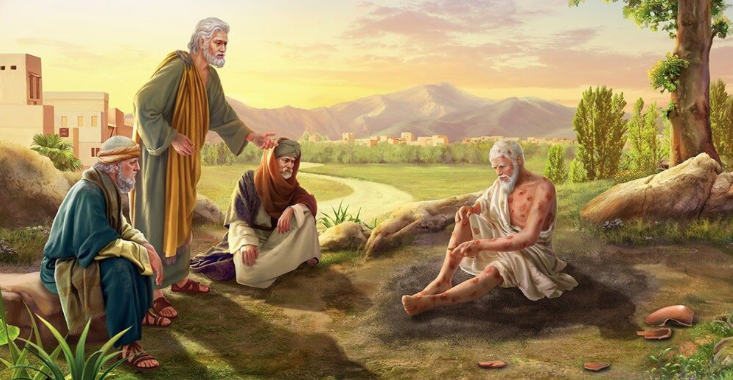
9. In Job 16:2, Job says of his friends, “Miserable comforters are ye all.” What mistakes did his friends make that we would want to avoid if we were talking with someone who had suffered such misfortune as Job had?
10. Which of the following do you consider to be major teachings to be gleaned from the Book of Job? (Be careful. Some of these may not even be true.)
- God sends trials and suffering to us to test us.
- If we are faithful to God, He will reward us handsomely both temporally and spiritually before we die.
- We will not always know why bad things happen to good people.
- A personal testimony of God’s existence and goodness and of our own standing before Him is essential to make it successfully through the trials of mortality.
- God is more powerful, wiser, and more loving than any of us could be at present.
- God is more powerful than Satan.
- We can and should trust the Lord even when we don’t understand what He is doing.
- Blessings come from successfully enduring trials.
- God does not necessarily immediately reward righteousness nor punish evil.
11. Why do you suppose God in the end gave Job double the number of camels, sheep, etc., but only the same number of children as he had once had?
Possible Answers to Points to Ponder in Job
1. What is there about the book of Job that would have led Victor Hugo to say, “The book of Job is perhaps the greatest masterpiece of the human mind” and Thomas Carlyle to say, “There is nothing written, I think, in the Bible or out of it, of equal literary merit”?
Two reasons:
- It is written in beautiful Hebrew poetry, the elegance of which is often lost on 21st-century English readers.
- It deals poignantly with one of the deepest of all theological questions: Why do bad things happen to good people?
2. Why do many Bible readers believe that Job was not actually an historical figure and that the Book of Job is just inspired fiction?
They argue:
- Satan does not, in fact, have free rein to roam around heaven, as Job 1 and 2 seem to portray.
- God wouldn’t stoop to “making a bet” with Satan, as though both were wagering on the outcome of the Super Bowl.
- The story is just too neat to be believable:
- Calamities come to Job in incredibly rapid succession.
- It seems that if he had really been “the greatest man in the East,” there would be some evidence of him outside of the Old Testament.
- His family is just too perfect to be believable, as is its double restitution at the end of the book. And Job himself is said to be “perfect” (1:1), which description we usually reserve for Jesus Himself.
- It seems unlikely that anyone in Job’s position or the position of his would-be comforters would go seven days without speaking. (Job 2:13.)
- A story doesn’t have to be historical to be inspired. For example, the prophet Nathan told David an invented story about a poor man with one little ewe lamb to illustrate a point. Many of Jesus’ parables, likewise, seem to have the same purpose. It is not necessary to believe there was really a Good Samaritan who did what he is reported to have done for the wounded man on the road to Jericho to appreciate the lesson of the parable by that name, nor that a specific merchant man really found an immensely valuable pearl and sold all he had to buy it.
3. Why do many others believe Job really existed?
They point out that:
- Ezekiel 14:14, James 5:11, and D&C 121:10 all mention him.
- The story is presented to us in the Old Testament as having really happened.
- The “neatness” of the story to which some critics object should pose no problem to an omnipotent God.
- Noah is also called “perfect” in the Old Testament (Gen. 6:9) and the Doctrine and Covenants asserts that the same was true of Seth (D&C 107:43). The word which is so translated can mean simply “complete, whole, or having integrity,” as the footnote to Genesis 6:9 explains, without requiring absolute infallibility.
- If we start questioning the historicity of parts of the Bible, it could lead to a loss of faith in its principles and teachings.
4. Which position do you personally find more convincing, and why?
Your choice. I personally doubt the literal accuracy of the story of Satan and God "betting" on Job’s integrity in chapters 1 and 2. I am quite open to the idea that there could well have been an historical Job who proved true to God despite terrible misfortunes. But my faith won’t be shaken if I someday am shown that the story was simply inspired fiction to teach important principles.
4a. How orthodox would it be for a Latter-day Saint to doubt the historical accuracy of the prologue to Job in chapters 1 and 2?
Chat GPT tells us: Current official Latter-day Saint teaching is quite clear that the prologue of Job is not normally to be understood as a literal report of a conversation in heaven between God and Satan. It is treated as a poetic/literary device used to introduce the central problem of the book: Why do righteous people suffer, and will they remain faithful when they do?
This is actually a significant clarification from older LDS commentary.
The current LDS position
The 2026 Come, Follow Me material says explicitly:
“The opening chapters of Job emphasize, in a poetic way, Satan’s role as our adversary or accuser; they don’t describe an actual interaction between God and Satan.”
Even more explicitly, a current August 2026 For the Strength of Youth article says that the scenes in chapters 1–2 in which Satan enters God's presence and receives permission to afflict Job “is a poetic invention.” It then points out that Lucifer had already been cast out of God's presence according to Latter-day Saint scripture.
That seems to answer your question rather decisively.
But this wasn't always presented quite so categorically
An older LDS Old Testament student manual took a somewhat more cautious approach. It said that the conversation “may be a poetic way of setting the stage” rather than an actual conversation. But it also allowed for the possibility that Satan's appearance among the “sons of God” could be understood literally.
Another LDS seminary manual was more explicit that the conversation is a “poetic conversation” and an “insightful literary device.” It says that God does not really make agreements with Satan because God has no need to bargain with him.
So there has been some evolution in LDS teaching:
Older approach:
Perhaps literal, perhaps poetic; in any event, God isn't really bargaining with Satan.
Current approach:
The heavenly conversation is a poetic invention/device, not an actual event.
4b. Where do scholars who believe Job was an historical figure believe the land of Uz was? When do they believe this story occurred?
ChatGPT tells us: There is no consensus, but among scholars who take Job to reflect a real historical person, the strongest geographical case today tends to put the land of Uz somewhere in or adjacent to Edom, southeast of Judah, rather than in northern Syria.
Where was Uz?
The evidence points broadly toward the Edom–northern Arabia region, probably somewhere east or southeast of the Dead Sea.
Several clues converge:
- Lamentations 4:21 directly connects Uz and Edom: “Rejoice and be glad, O daughter of Edom, that dwellest in the land of Uz.”
- Job's friend Eliphaz is a Temanite. Teman is strongly associated with Edom and was famous in the Bible for wisdom.
- Uz is the name of a person in the Edomite genealogy in Genesis 36:28.
- Job is described as the greatest of the “men of the east” (Job 1:3).
- The other peoples mentioned in the story—Shuah, Tema, Buz, Dedan, and the Chaldeans—fit quite naturally into the broader Arabian/Syro-Arabian world.
- The ancient Greek tradition preserved with the Septuagint says that Job's country was on the borders of Edom and Arabia.
A modern scholarly handbook therefore says that, although northern Mesopotamia is possible, “the preponderance of indirect evidence appears better to point in the direction of Edom.”
So I would picture Uz not as a little town but as a region on the southeastern frontier of the biblical world—roughly southern Jordan/northwestern Arabia, perhaps extending toward the desert.
There is an interesting alternative: some scholars have located Uz in northern Syria/Hauran, around the region south of Damascus. Ancient Syrian tradition placed Job there, and there are geographical arguments for it. But the Edomite hypothesis has considerable biblical evidence behind it.
When would the historical Job have lived?
This is even more interesting because the internal picture of Job looks very much like the patriarchal age.
Scholars who regard Job as a historical figure and take the story's setting seriously commonly put him somewhere around the second millennium BC, roughly the era of Abraham, Isaac, and Jacob.
The clues include:
1. His enormous livestock holdings.
Job's wealth is measured almost entirely in sheep, camels, oxen, donkeys, and servants—very much like the patriarchal descriptions of Abraham, Isaac, and Jacob.
2. Job functions as the religious head of his household.
He personally offers sacrifices for his children (Job 1:5). There is no priesthood, temple, or Israelite sacrificial system in the picture. That fits a pre-Mosaic patriarchal setting remarkably well.
3. His extraordinary longevity.
After his restoration, Job lives another 140 years (Job 42:16). That is strikingly similar to the long lifespans of the patriarchs: Abraham 175, Isaac 180, Jacob 147.
4. The qesitah.
Job 42:11 says his relatives gave him a qesitah, a unit of money/property. Elsewhere in the Bible the term occurs notably in Jacob's time (Genesis 33:19; Joshua 24:32), another small indication of an early setting.
5. The absence of Israel.
Job isn't described as an Israelite, and there is no mention of Moses, the Exodus, Sinai, the Law, Jerusalem, the temple, or the Israelite monarchy.
Put together, these clues make a patriarchal-era setting—perhaps roughly 2000–1500 BC—quite plausible if one accepts the story as having a historical core. One scholarly treatment specifically notes that the material culture and social/religious features fit the second millennium BC.
But here's the important qualification
We have to distinguish the date of Job the man from the date when the Book of Job was written.
Those could be separated by many centuries.
A very common scholarly position is something like:
The story purports to take place in the patriarchal age, but the book in its present poetic form was composed much later.
Indeed, the Hebrew of Job is unusual and contains linguistic features that have led scholars to propose dates ranging from the pre-Israelite/patriarchal period all the way to the post-exilic period. There is no scholarly agreement about when the book reached its present form.
And that distinction actually fits rather well with the LDS approach we were discussing in your previous question.
You could have:
A real Job → a real ancient man who lived in the patriarchal era in the Edom/northern Arabian region → a genuine tradition about his suffering → centuries later, a gifted Hebrew poet/theologian constructs the magnificent poetic book we now have, including the literary prologue.
That allows us to take Job as historical without having to regard every scene and speech in the present book as a stenographic historical transcript.
One particularly fascinating possibility
There is an old tradition identifying Job with Jobab, one of the early kings of Edom mentioned in Genesis 36:33. The Septuagint actually makes a connection between Job and Jobab. Most modern scholars don't regard the identification as established, but it is intriguing because it would put Job squarely in the Edomite patriarchal world.
4c. So, what answer does the book of Job finally give to the question of why bad things happen to good people, or good things to bad people?
It never really proposes an answer but teaches or implies:
- Suffering is not always caused by sin.
- God is smarter than we are,
- We should trust Him.
Alma commanded his people “that they should preach nothing save it were repentance and faith on the Lord.” (Mosiah 18:20) The Lord gave similar instructions to early missionaries in our day. (D&C 19:31.) It is often useful to use the same standard when studying the scriptures, asking what in a given chapter tends to increase our faith and/or what may move us to repentance. Both faith and repentance can be further subdivided, as we will see below.
5. What in this week’s reading could tend to increase our faith in the reality, power, and goodness of God?
The ending of the Book of Job, which:
- Emphasizes God’s superiority in power, wisdom, and goodness to that of man.

- Shows that God blessed Job in the end with double the temporal blessings which he had once had.

6. What in this week’s reading could tend to increase our conviction of the divinity of The Church of Jesus Christ of Latter-day Saints?
- Job 38:4-7, which speaks clearly of a pre-mortal life, when “all the morning stars sang together, and all the sons of God shouted for joy” at the announcement of God’s plan for our mortality.
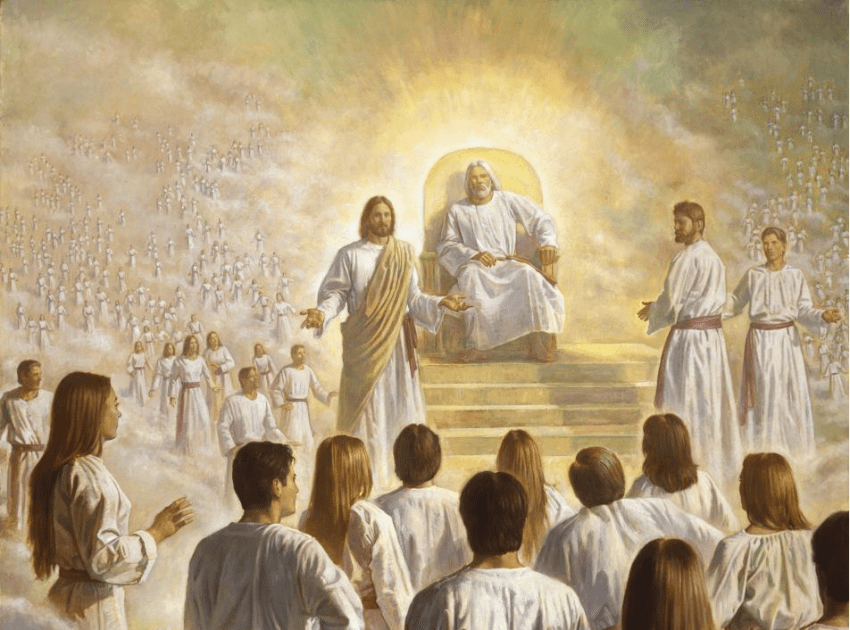
- Job 19:25-26, which testifies that
- We can know for ourselves of God’s existence
- There will be a literal, physical resurrection, where we will see God “in the flesh,” and not merely some sort of “spiritual resurrection.”
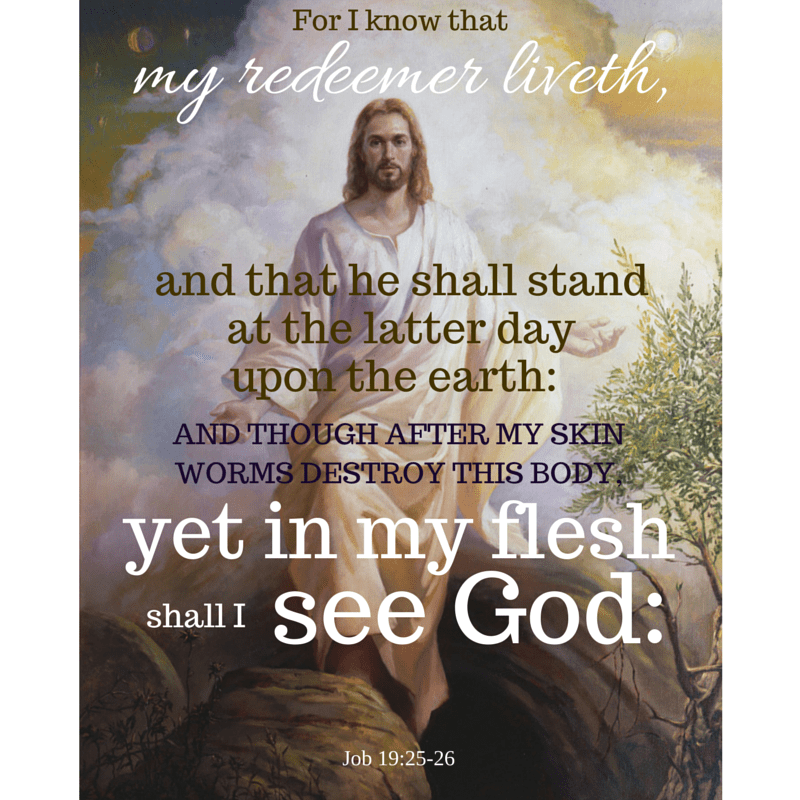
- Job literally saw God (42:5), just as other prophets before and since have done.

7. What in this week’s reading tends to motivate you to live better?
Job’s strength and integrity are displayed in virtually every chapter. If he could remain faithful in the face of such challenges, so can we.
8. What in this week’s reading provides helpful instruction on how to live better?
- Don’t let another (like Job’s friends) lead you with their “inspiration.”
- Don’t judge another by his current circumstances, as Job’s friends did.
- We each need to strive to have a personal conviction of our own worthiness in God’s sight, as Job did. (Job 13:18)
9. In Job 16:2, Job says of his friends, “Miserable comforters are ye all.” What mistakes did his friends make that we would want to avoid if we were talking with someone who had suffered such misfortune as Job had?
At a minimum, we would want to
- Do a lot more listening and less talking.
- Be a lot more loving and less judgmental.
- Not assume that we had all the answers.
- Not assume that temporal trouble was a result of sin.
10. Which of the following do you consider to be major teachings to be gleaned from the Book of Job?
I personally believe those highlighted in red to be true.
- God sends trials and suffering to us to test us. [God does not necessarily send the trials and suffering, but He does allow us to pass through them sufficiently to refine us and prepare us for exaltation. Perhaps the difference is inconsequential.]
- If we are faithful to God, He will reward us handsomely both temporally and spiritually before we die. [Job is probably an exception to the rule. Many of God’s blessings for righteousness are spiritual, rather than temporal, and some will not come until the life to come.]
- We will not always know in this life why bad things happen to good people.
- A personal testimony of God’s existence and goodness and of our own standing before Him is essential to make it successfully through the trials of mortality.
- God is more powerful, wiser, and more loving than any of us could be at present.
- God is more powerful than Satan.
- We can and should trust the Lord even when we don’t understand what He is doing.
- Blessings come from successfully enduring trials.
- God does not necessarily reward righteousness nor punish evil immediately.
11. Why do you suppose God in the end gave Job double the number of camels, sheep, etc., but only the same number of children as he had once had?
While we can’t know for sure, one possible reason is that given the eternal nature of the family, Job did end up with double the number of children, as those who had died would still be his in eternity.
Relevant Cartoons for Your Enjoyment


 |
| Job 19:25 |
 |
| Job 21-24 |
 |
| Job 38-41 |
 |
| Job 42 |


Comments
Post a Comment