Points to Ponder in Joshua 1-8, 23-24

To accompany your Come, Follow Me study for May 18-24.
In addition to reading these chapters from Joshua, you may enjoy:
- The related Old Testament Study Helps at Joshua 1–8; 23–24.
- Any or all of the following videos:
- The corresponding commentary in the Institute Student Manual in the online Gospel Library.
- The remaining chapters from the book of Joshua, especially chapter 10, which tells the remarkable story of the sun standing still.
If you would like a Kahoot game related to this material which you could use for your own review or to use with your family or class, click here: https://create.kahoot.it/share/joshua-1-8-23-24/d41c729f-6a99-4570-b7ab-9f7aea2c0ac2
Points to Ponder in Joshua 1-8 and 23-24
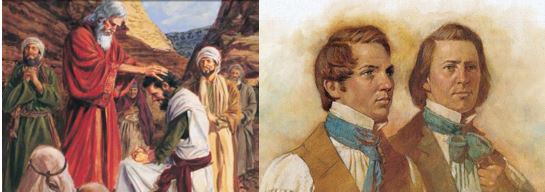
1. In what ways was Joshua’s relationship to Moses similar to Brigham Young’s relationship to Joseph Smith?
2. Which passage in Joshua do you think was once recited at the opening exercises of Latter-day Saint youth activity nights?
3. Why was Rahab, a prostitute, and her family spared when the rest of Jericho was destroyed? How can her act of lying be defended?

4. Why did the Lord dam up the Jordan River when the Israelites came at flood stage—beyond simply making the crossing safe? What parallels can we find in how He helps us today?

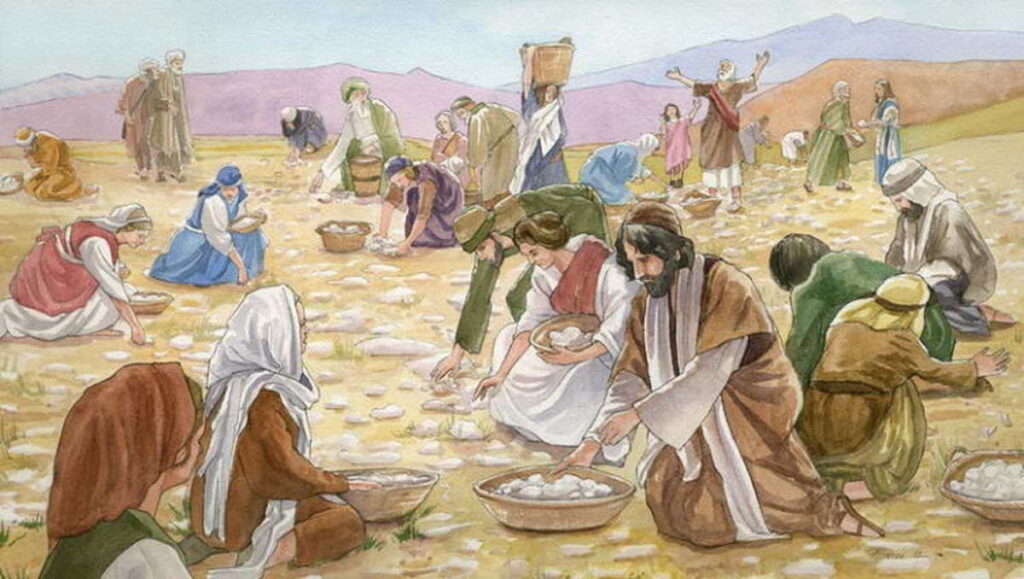
5. At what point did the Lord stop sending manna to the Israelites? What general lessons can we learn from that timing?
6. Which passage in this week’s reading best illustrates Ether 12:6—that we receive no witness until after the trial of our faith?
7. Which passage in this week’s reading may have inspired one of the verses in the hymn “How Firm a Foundation”?
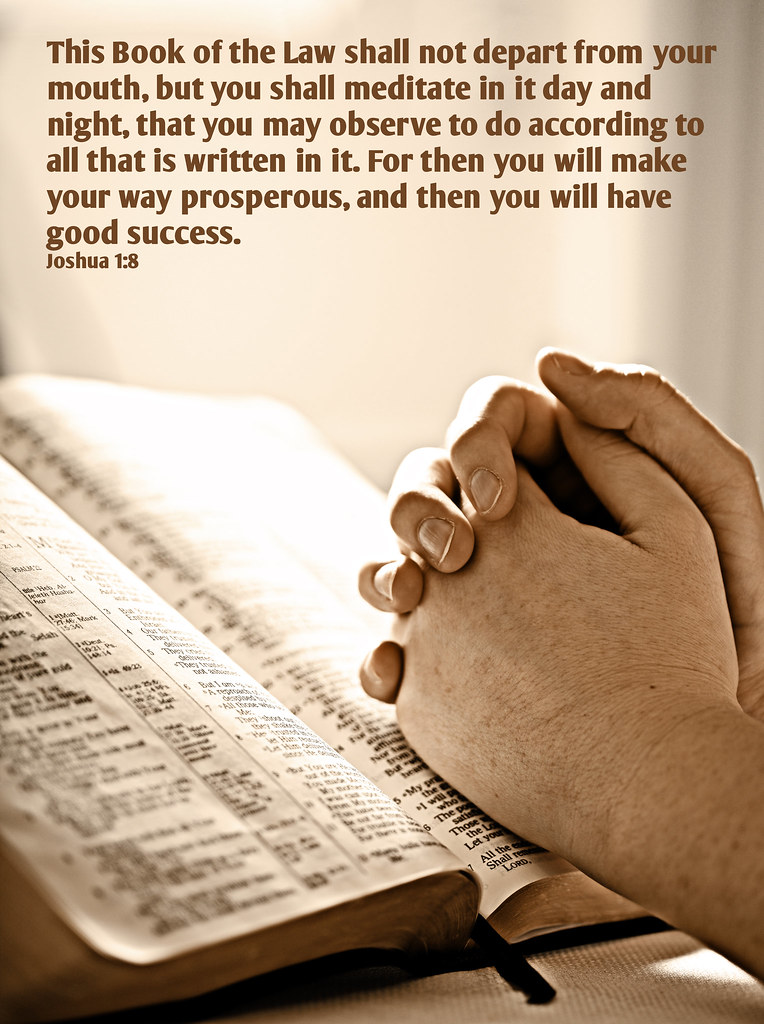
8. What two pieces of counsel in Joshua 1:8 seem most significant regarding how we should use the scriptures? What can we conclude about those who read the scriptures constantly yet remain materially poor?
9. Which hymn best summarizes the principle found in the Lord’s instructions to the tribes of Reuben, Gad, and the half-tribe of Manasseh in Joshua 1:12–15?
10. What do you think the Lord meant by telling the Israelites to “sanctify” themselves in Joshua 3:5? How might we apply that principle today?
11. What would be the modern equivalent for us of the twelve stones that marked where the Jordan River was parted?

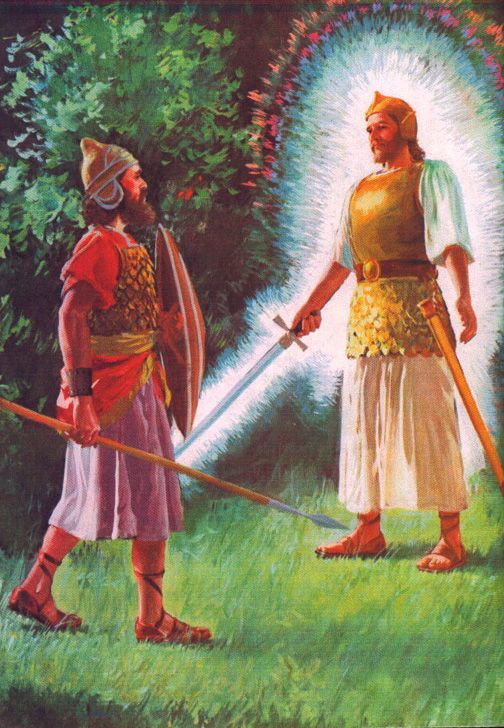
11a. Who do we suppose was "the captain of the Lord's host" who appeared to Joshua in Joshua 5:13-15?
12. Why was the visit of the “captain of the host of the Lord” in Joshua 5:13–15 significant?
13. What possible justification might there be for executing not only Achan but his family for taking forbidden spoils from Jericho?
Possible Answers to Points to Ponder in Joshua 1-8, 23-24
1. In what ways was Joshua’s relationship to Moses similar to Brigham Young’s relationship to Joseph Smith?
- Both succeeded an even more illustrious predecessor.
- Both were confirmed as the Lord’s designated successor through miraculous means.
- Both led their people into a “promised land” which their predecessors had foretold but never entered themselves.
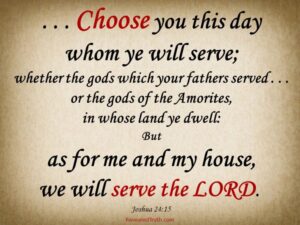
2. Which passage in Joshua do you think was once recited at the opening exercises of Latter-day Saint youth activity nights?
The last part of Joshua 24:15.
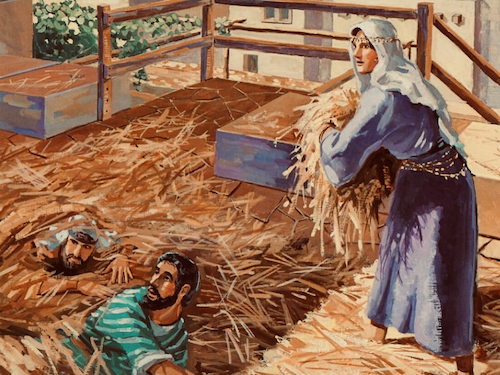
3. Why was Rahab, a prostitute, and her family spared when the rest of Jericho was destroyed? How can her act of lying be defended?
Evidently she was converted to the Israelites’ religion and believed in their God, despite her previous lifestyle. In any case, Jesus taught that harlots would enter the kingdom of God before the Pharisees of His day. Rahab’s lying was to protect the life of the Lord’s servants, not to take unfair advantage of others for her own selfish purposes.
4. Why did the Lord dam up the Jordan River when the Israelites came at flood stage—beyond simply making the crossing safe? What parallels can we find in how He helps us today?
The biggest reason for the miracle was probably not just to get the people across the river but to convince them that their new leader, Joshua, had the same divine approval that Moses had had, who similarly exercised divine power to divide a body of water. In our day, the Lord generally provides a less visible but even more convincing spiritual witness of the divine calling of His leaders, to those who will seek it.

5. At what point did the Lord stop sending manna to the Israelites? What general lessons can we learn from that timing?
After coming six days a week for 40 years, the manna ceased “on the morrow after they had eaten of the old corn of the land.” The Lord reminds us thereby that He will do for us only what we cannot do for ourselves.
6. Which passage in this week’s reading best illustrates Ether 12:6—that we receive no witness until after the trial of our faith?
Probably Joshua 3:15-16, which tells us that the waters of the Jordan were not dammed up until the priests bearing the ark actually dipped their feet into the water.

7. Which passage in this week’s reading may have inspired one of the verses in the hymn “How Firm a Foundation”?
Probably Joshua 1:9, which sounds a lot like verse 3: “Fear not, I am with thee, oh, be not dismayed. For I am thy God and will still give thee aid.”

8. What two pieces of counsel in Joshua 1:8 seem most significant regarding how we should use the scriptures? What can we conclude about those who read the scriptures constantly yet remain materially poor?
The most significant counsel would seem to be that
- We should not just read them superficially but constantly think deeply about them.
- We should seek to apply every particle of them in our daily lives.
The promised prosperity is not necessarily temporal, so we can’t conclude anything about impoverished scripture readers other than that they are undoubtedly blessed in ways far more significant than financially.
9. Which hymn best summarizes the principle found in the Lord’s instructions to the tribes of Reuben, Gad, and the half-tribe of Manasseh in Joshua 1:12–15?
Perhaps #219, which reminds us, “Because I have been given much, I too must give.” These tribes had already reached their own promised lands, but the Lord asked them to help their fellow Israelites who still needed to fight for theirs.

10. What do you think the Lord meant by telling the Israelites to “sanctify” themselves in Joshua 3:5? How might we apply that principle today?
He probably expected that at the very least, they would pray and repent of any inappropriate activities and attitudes before expecting His assistance in the battles ahead. We might do likewise before any major event in our lives wherein we feel a special need for divine assistance. For example, Nephi tells us in 2 Nephi 32:9 that “ye must not perform any thing unto the Lord save in the first place ye shall pray unto the Father in the name of Christ, that he will consecrate thy performance unto thee, that thy performance may be for the welfare of thy soul.” Fasting could be added, where appropriate, though there is no evidence that the Lord expected Israelite armies to fight on an empty stomach. In Exodus 19:10, when the Lord told Moses to sanctify the people in preparation for their encounter with God on Mount Sinai, He added that they were to wash their clothes. We might likewise want to make sure we are wearing clean and appropriate clothes when we go to meet with God at church or at the temple.
11. What would be the modern equivalent for us of the twelve stones that marked where the Jordan River was parted?
The stones were to serve as a visual reminder to the Israelites of the miracle the Lord had done for them. In our day, we can get much of the same benefit from:
- Photos of significant events in our lives.
- Personal histories
- Postings to the Memories section of FamilySearch
- Paintings hung in our homes
- Visitors' centers and monuments the Church has erected at places of importance in our history
- Objects in the Church History Museum
- Sacred clothing worn by those who have made temple covenants
11a. Who do we suppose was "the captain of the Lord's host" who appeared to Joshua in Joshua 5:13-15?
As summarized by ChatGPT, Latter-day Saint commentators have suggested two main possibilities:
1. Jehovah (the premortal Jesus Christ) — the most common Latter-day Saint view
Many Latter-day Saint writers identify the captain as Jehovah, the premortal Jesus Christ.
Reasons they give:
-
The command to remove shoes on holy ground parallels the divine appearance to Moses.
-
Joshua falls on his face and worships (Josh. 5:14), and the figure does not refuse the reverence.
-
In LDS theology, Jehovah is the God of the Old Testament, who frequently appears personally to prophets.
Some LDS scholars who lean this way include:
-
Sidney B. Sperry
-
Hugh Nibley (suggests divine manifestation traditions behind such appearances)
Under this interpretation, the episode is essentially a theophany—Jehovah appearing to Joshua before the conquest begins, confirming that the battle belongs to the Lord.
2. Michael the Archangel (Adam) — another LDS interpretation
Other Latter-day Saint commentators think the captain may be Michael (archangel), whom LDS doctrine identifies with Adam.
Why this suggestion appears:
-
Michael is described in scripture as a leader of heavenly armies (see Revelation 12:7).
-
The title “captain of the host” sounds like a military command position rather than God Himself.
-
In LDS theology, Michael/Adam plays a major role in divine governance and in leading heavenly hosts.
Some LDS teachers therefore see the figure as a high-ranking angelic commander acting under Jehovah’s authority.
3. The cautious position (some LDS scholars)
A number of LDS commentators simply say the text does not identify him explicitly, so either a divine manifestation or a chief angelic commander is possible.
The narrative’s main point, in their view, is that Israel’s battles are directed by heaven, not merely by Joshua’s strategy.
12. Why was the visit of the “captain of the host of the Lord” in Joshua 5:13–15 significant?
It may have been to comfort and strengthen Joshua prior to his campaign against Jericho and to reassure him that the Lord was ready to fight their battles.
13. What possible justification might there be for executing not only Achan but his family for taking forbidden spoils from Jericho?
As harsh as it seems, the following or a combination of them could be possible reasons:
- Achan’s family members were co-conspirators with him and could be considered just as guilty.
- Having been subject to the wicked influence of Achan, it was better for his family to be ushered quickly into the spirit world than to be left to ripen in the same iniquity and thus be guilty of sins as grave as those of Achan himself.
- Though possibly innocent themselves, the execution of Achan’s family members served as a powerful warning to other Israelites. If this was the case, the innocent family members would have been ushered into a much happier place, where eternal blessings could still await them.


Comments
Post a Comment